Python Excel automation at Delta Air Lines
Published · Last Updated
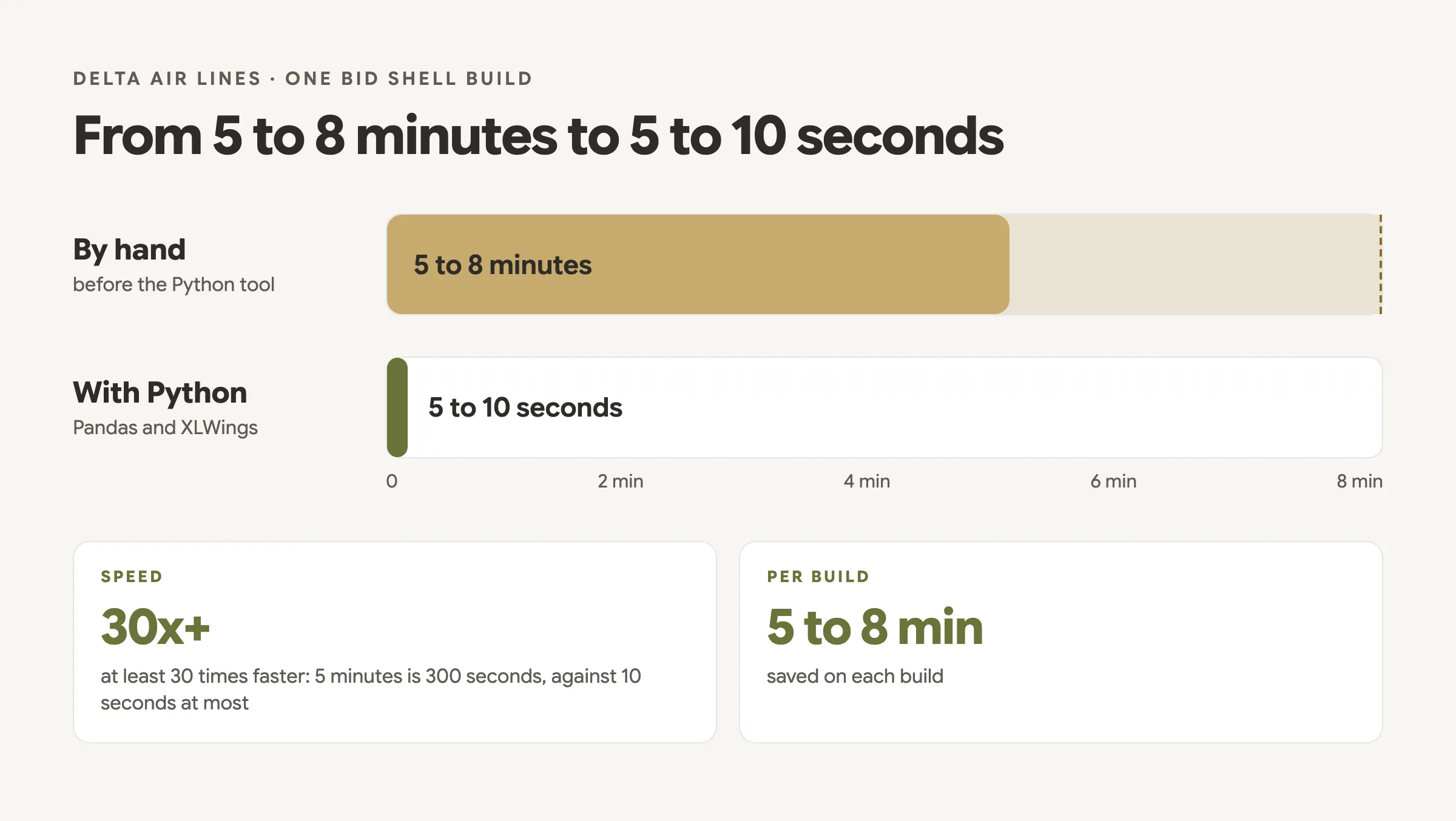
Python Excel automation means a script builds the workbook a person built by hand. At Delta Air Lines, Drake brought Python into the department and built a tool with Pandas and XLWings that cut each bid shell build from 5 to 8 minutes to 5 to 10 seconds. Drake also sorted complaint data into 20+ groups with text clustering.
What did Python Excel automation change at Delta?
It cut the time to build one bid shell from 5 to 8 minutes to 5 to 10 seconds. Drake built the tool in Python with two Python libraries, Pandas and XLWings. At the slow end of the old range, 5 minutes is 300 seconds. Against the tool's slowest run of 10 seconds, that makes the tool at least 30 times faster.
Delta Air Lines was never a client of ours. Drake did this work in-house at Delta, and we share it because it shows the kind of work we do: find a task that eats minutes each time, then turn it into a script that takes seconds.
How does Python Excel automation work?
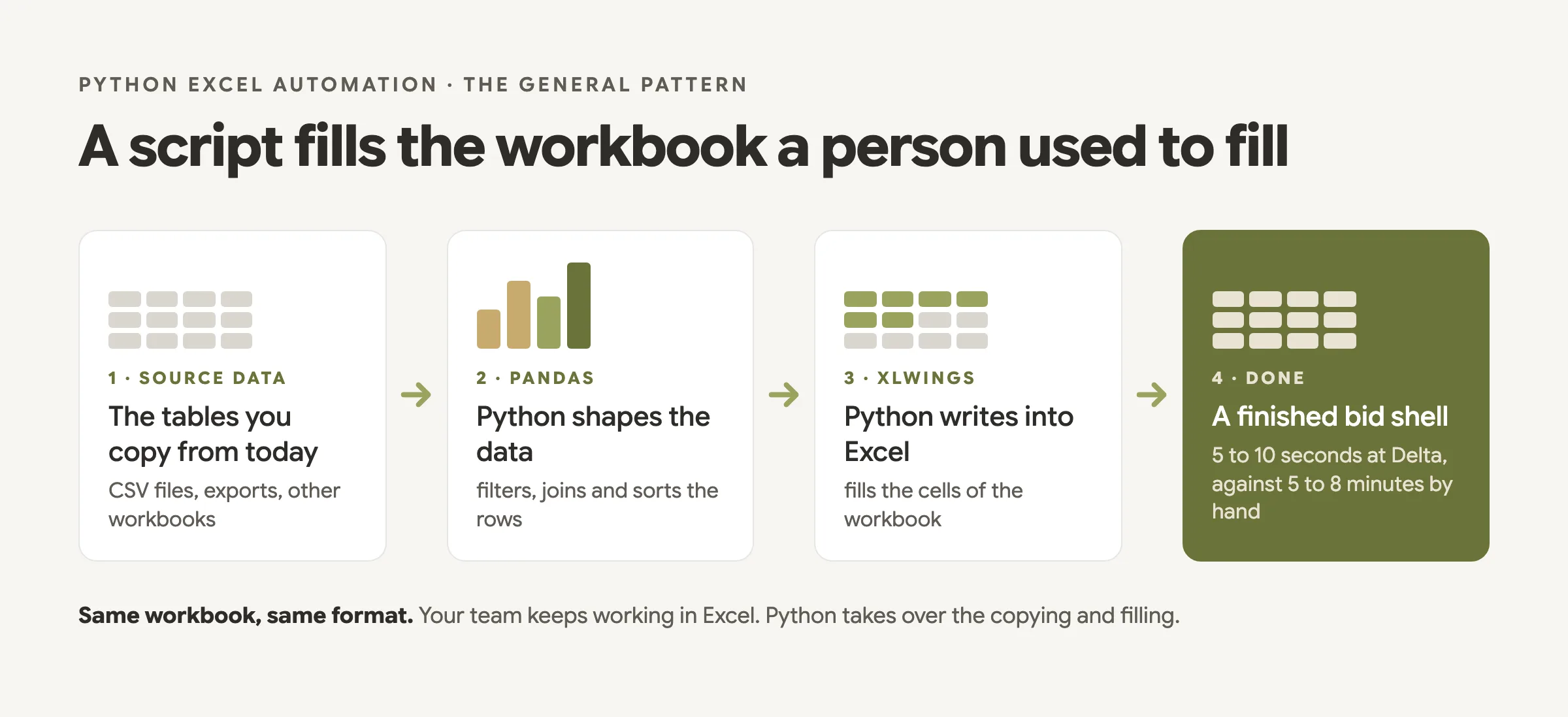
A Python script repeats the steps a person takes in a workbook, in seconds. Pandas, a Python library for tables of data, reads the rows and shapes them. XLWings, a Python library that reads and writes Excel workbooks, puts the result into the file. Your team keeps working in Excel, and the script does the filling.
Most tools of this kind follow 4 steps:
- Read the source tables, such as CSV files, exports or other workbooks.
- Shape the rows with Pandas: filter them, join them and sort them.
- Write the result into the workbook with XLWings.
- Save a finished file in the same format as the one built by hand.
Drake's tool at Delta used Python, Pandas and XLWings to build each bid shell in 5 to 10 seconds. The figure shows the general pattern, not Delta's files. Our data engineering work runs on the same idea: a script applies the same rules to each row, so the result comes out the same each time.
Why add Python to a department's tech stack?
Python lets you turn a task you repeat into a script that runs the same way each time. A tech stack is the set of software a team uses to do its work. Before Drake's tool, the department's stack had no Python, and each bid shell took 5 to 8 minutes to build.
Drake brought Python into that stack, then built the bid shell tool with it. The skills behind this kind of work are in demand. The Bureau of Labor Statistics projects data scientist jobs to grow 35 percent from 2025 to 2035, with about 24,800 openings each year.
You don't need to hire a data scientist to start. One script that fills one workbook is a first step, and you can time it against the manual build to see what it saves.
How does text clustering sort complaint data?
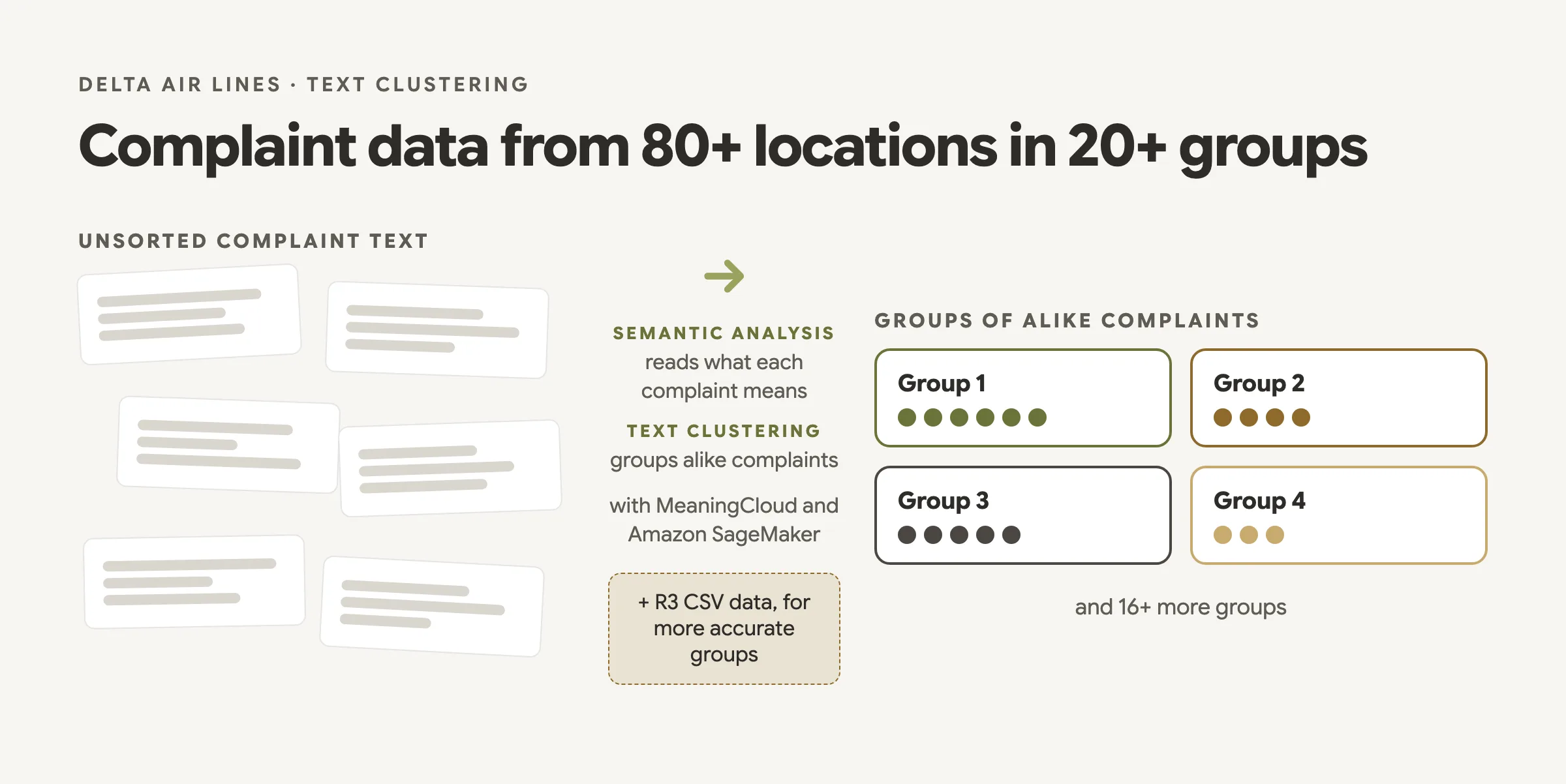
Text clustering groups pieces of text by how alike their meaning is, so similar complaints land in the same group. At Delta, Drake ran semantic analysis and text clustering with MeaningCloud and Amazon SageMaker. The work grouped complaint data from 80+ locations into 20+ high-similarity categories.
Semantic analysis reads what a piece of text means, beyond its exact words. Two customers can describe the same problem in different words. Semantic analysis lets the clustering put both complaints in one group, so you can count complaints by kind before you read each one.
What did the R3 CSV data add?
It made the clusters more accurate. Drake added R3 CSV datasets to the machine learning workflows, to improve clustering accuracy and to support customer service insights drawn from data. CSV is a plain text table format that Python and most machine learning tools can read.
How can a small business use Python Excel automation?
Start with the workbook your team rebuilds by hand most often, and time one build. Most U.S. firms are small: the SBA Office of Advocacy counts 36,207,130 small businesses, 99.9 percent of all businesses. Machine learning tools like the ones above are still rare in the smallest firms. The Census Bureau reports that less than 20% of firms with four or fewer employees reported using AI.
A script that fills one workbook needs no new app for your team. You can follow 4 steps:
- Pick the workbook your team rebuilds most often from the same sources.
- Time one build by hand. At Delta, one bid shell took 5 to 8 minutes.
- Write down each step: where the data comes from, what gets filtered and which cells get filled.
- Script those steps in Python, then compare the script's file with one built by hand.
Our six-step method starts the same way: we spend time inside your business and learn how it runs today, workarounds included. For complaint data, our data analysis stage starts from your question, like which complaints come up most. If a spreadsheet eats hours of your week, tell us about it.
FAQ
Was Delta Air Lines a Griffith Consulting Group client?
No. Drake did this work in-house at Delta Air Lines, and Delta was never a client of Griffith Consulting Group.
What is XLWings?
XLWings is a Python library that reads and writes Excel workbooks. It lets a Python script fill a workbook a person used to fill by hand.
What is text clustering?
Text clustering is a machine learning method that groups pieces of text by how alike their meaning is. At Delta it grouped complaint data from 80+ locations into 20+ categories.
How much faster was the bid shell build with Python?
It went from 5 to 8 minutes by hand to 5 to 10 seconds with the Python tool. That is at least 30 times faster.
Can a small business use Python Excel automation?
Yes. Any workbook your team rebuilds by hand from the same sources is a candidate. Time one build, write down the steps, then script them.

About the author
Drake founded Griffith Consulting Group, which finds where operations lose time and uses AI to fix it. At Delta Air Lines, Drake brought Python to the department, built a tool that cut the bid shell build from 5 to 8 minutes to 5 to 10 seconds, and used machine learning to sort complaint data into 20+ categories.
After college Drake became CTO of Actual Intelligence Labs, looked at businesses through an AI lens, found what to optimize and built the changes with real clients. In college Drake worked in digital engineering at Cause and Effect and managed six clients. Drake holds a B.S. in Industrial Engineering from Georgia Tech (spring 2026) and has been Lean Green Belt certified since June 2025. Read more about Drake.